"Conventional NDT Services" typically refers to traditional Non-Destructive Testing (NDT) methods used to evaluate the integrity and properties of a material, component, or system without causing damage. These are widely used in industries like oil & gas, aerospace, construction, and manufacturing.
Here are the main types of Conventional NDT Services:
-
1. Radiographic Testing (RT):
- Description: X-rays or gamma rays are used to examine the internal structure.
- Used For: Detecting internal cracks, voids, or inclusions in welds or castings.
-
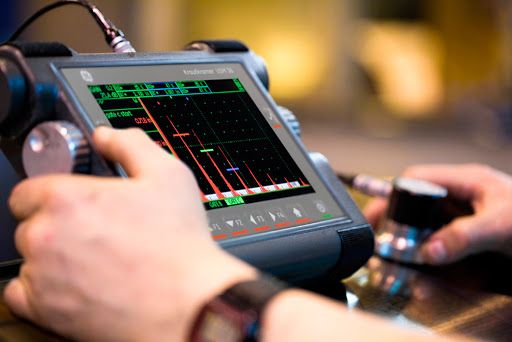
2. Ultrasonic Testing (UT):
- Description: Uses high-frequency sound waves to detect internal flaws or thickness.
- Used For: Weld inspection, corrosion mapping, material thickness measurement.
-
3. Magnetic Particle Testing (MPT):
- Description: Magnetic fields and iron particles are used to find surface and near-surface discontinuities in ferromagnetic materials.
- Used For: Surface crack detection in welds, fasteners, and structural steel.
-
4. Liquid Penetrant Testing (PT):
- Description: Dye or fluorescent penetrant is applied to a surface, then drawn out of defects by capillary action.
- Used For: Surface-breaking defects on non-porous materials, both ferrous and non-ferrous.
-
5. Visual Testing (VT):
- Description: Inspection using the naked eye or tools like magnifying glasses, borescopes, or video scopes.
- Used For: Surface defects like cracks, corrosion, misalignments, weld quality.
-
6. Eddy Current Testing:
- Description: Uses electromagnetic induction to detect surface and near-surface flaws.
- Used For: Cracks, material thickness, conductivity, and heat treatment verification.